
💡 In This Guide:
Outsourcing IT work can save money and provide access to global talent, but many initiatives fail or land at mediocre results because businesses do not understand and manage the critical challenges across the whole project lifecycle. The primary difficulties fall into four categories: communication and coordination gaps, project management and technical deficiencies, vendor relationship and cultural issues, and external economic constraints.
The global IT outsourcing market keeps growing, but the path to success is often bumpy. This guide walks through the common challenges businesses face when outsourcing IT projects — and how to navigate each one effectively.
1What Is IT Outsourcing, and Why Do Businesses Use It?
IT outsourcing is a contractual relationship where a client organisation delegates some or all of its software development or IT activities to an external third-party vendor in exchange for agreed compensation. Companies in developed economies increasingly turn to managed IT services to access cost savings, skilled labour, and reduced operational expenses offered by vendors in developing countries.
The Primary Drivers for Outsourcing
- Cost efficiency — high cost savings through access to lower-wage markets and reduced operational expenses
- Talent accessibility — an extensive global talent pool not available locally via an offshore development team
- Business focus alignment — internal teams concentrate on core activities while the vendor handles the rest
- Scalability — flexible, rapid scaling to meet changing business demands
- Operational flexibility — adapting quickly to changing circumstances
- Deployment speed — dedicated development teams accelerate time to market
- Technical expertise — advanced or specialised skills that exceed what the internal IT department can provide
The most popular outsourcing destinations remain in Asia, led by India, China, and Malaysia — regions that have invested heavily in infrastructure and skilled engineers to attract international clients. Some businesses prefer nearshore outsourcing to nearby countries with similar time zones, while others opt for onshore outsourcing within their own country to minimise cultural and communication barriers. Organisations can choose between offshore, nearshore, onshore, or hybrid models, with service scope ranging from a single engagement to full end-to-end services.
2
The Four Categories of IT Outsourcing Challenges
Comprehensive research analysing multiple outsourcing projects groups the major challenges into four distinct categories. Understanding these categories helps businesses anticipate problems before they derail projects. Frequency of occurrence varies from occasional to persistent, but business impact can range from moderate to severe regardless of how often a challenge appears.
Financial consequences of unresolved challenges range from budget increases to major financial losses affecting both immediate project costs and long-term business performance. Mitigation difficulty varies from moderate to difficult depending on the specific challenge, while project sensitivity can be high-risk for business-critical initiatives. Let's examine each category in detail.
3
Communication, Culture, and Time-Zone Gaps
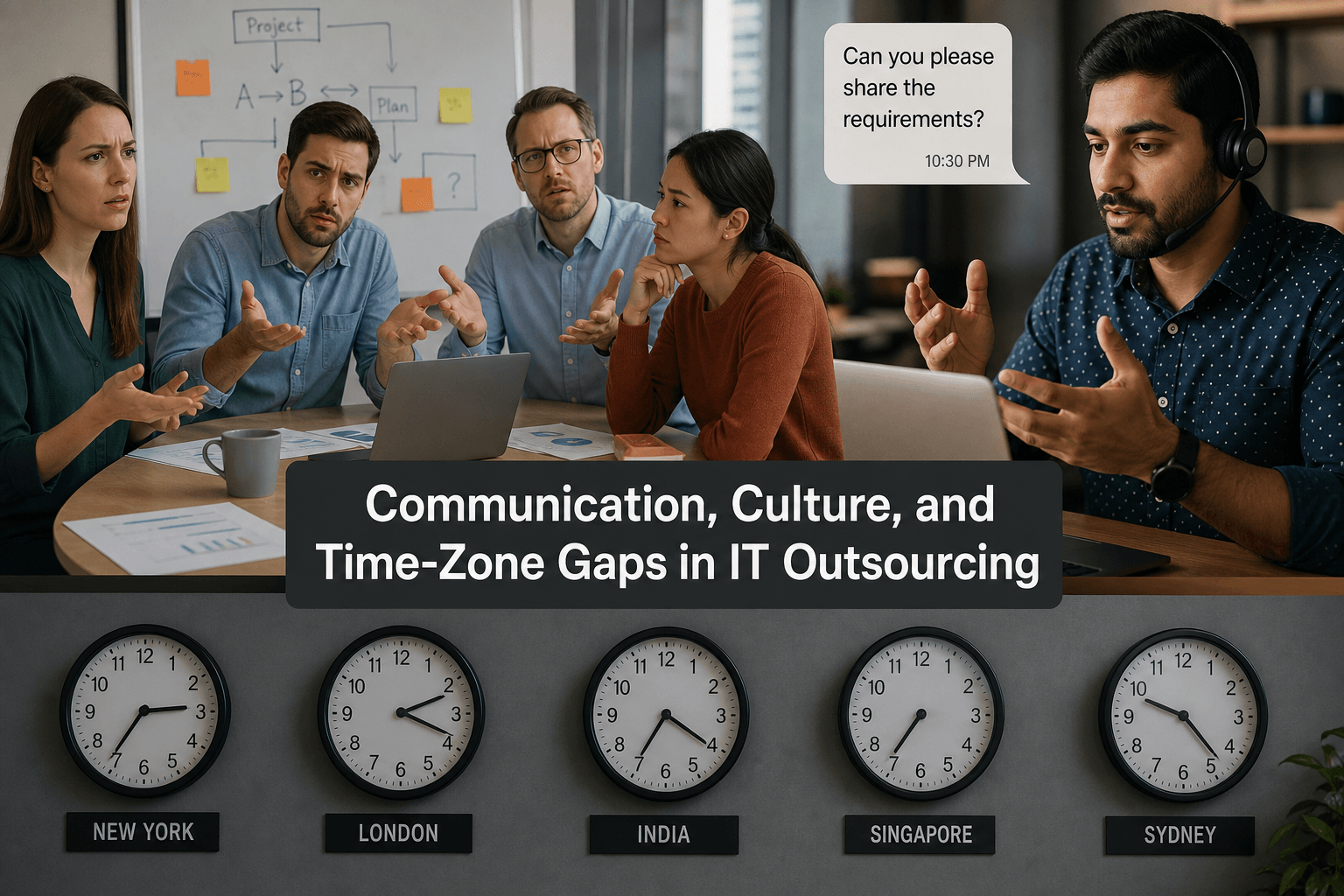
Clear communication is the foundation of successful IT projects, yet it becomes significantly harder when teams are distributed globally. The lack of face-to-face interaction between client and vendor personnel can lead to breakdowns in communication and misunderstandings about requirements.
How Communication Barriers Manifest
- Language proficiency variations mean nuances and technical details get lost even in a shared language like English
- Cultural differences in communication style create confusion — in some cultures "we'll see" means "no", in others it means "maybe"
- Reliance on written communication without visual cues increases the risk of misinterpretation
- Different communication tools and protocols between organisations create friction
Response time between questions and answers can stretch across days due to time-zone differences, and meeting effectiveness suffers when participants join from different locations with varying audio and video quality. One study of a German-Indian outsourcing partnership found the project ultimately failed due to communication breakdowns — even with instant messaging in place — because power distance and cultural differences made coordination more challenging than anticipated.
Cultural Dimensions That Create Friction
| Cultural Dimension | Western Approach | Eastern/Southern Approach |
|---|---|---|
| Communication | Direct and explicit | Indirect and implicit |
| Decision-making | Individual authority | Group consensus |
| Hierarchy | Flatter structures | Strong hierarchy |
| Time orientation | Strict deadlines | Flexible scheduling |
| Conflict handling | Open confrontation | Harmony preservation |
IT professionals in outsourcing relationships function within two organisational cultures simultaneously — their employer's and the client's — which can create confusion and stress even among professionals who adapt well. Research comparing Western and Korean outsourcing approaches found Western organisations tend to prioritise flexibility and control, while Korean organisations emphasise reliability and relationship building; mixing these approaches without understanding creates friction.
4
Requirement Misunderstandings and Loss of Control
Requirement misunderstandings are particularly dangerous because they compound over time. When initial requirements are unclear, the resulting deliverables inevitably miss the mark — and by the time errors surface, significant time and money have been wasted.
Common Causes of Requirement Misunderstandings
- Incomplete documentation that leaves room for interpretation
- Cultural assumptions about how things should work
- Lack of visual aids like wireframes or prototypes
- Insufficient feedback loops to catch issues early
- Language barriers that obscure technical details
A well-crafted business requirements document (BRD) is the foundation for project success — it should clearly define functional requirements, technical specifications, and acceptance criteria, with the product owner actively participating in requirement gathering. Without clear scope definition and change-request mechanisms, scope creep becomes inevitable, leading to budget overruns and timeline delays.
Losing Direct Control over Outsourced Teams
When you outsource, you're trusting another organisation to represent your interests — and that loss of direct control creates risks many companies underestimate. The outsourced workforce operates under the vendor's management, not yours.
- Less visibility into daily work and progress
- Difficulty enforcing quality standards without being present
- Limited ability to redirect priorities quickly
- Dependence on vendor reporting that may be inaccurate or incomplete
- Reduced influence over team morale and motivation
The traditional outsourcing model, based on paying for full-time equivalents (FTEs), actually incentivises vendors to keep people busy rather than drive efficiency. As one CIO put it: "If you pay by the FTE, why would your provider use AI? That would reduce their revenue and margin."
A strong service-level agreement (SLA) should define expectations and establish an escalation process, backed by regular delivery management reviews. Stakeholders in outsourcing relationships frequently cite low employee morale and loss of managerial control as significant concerns — when you can't directly manage people, their motivation and performance can suffer.
5
Quality, Security, and IP Protection Risks
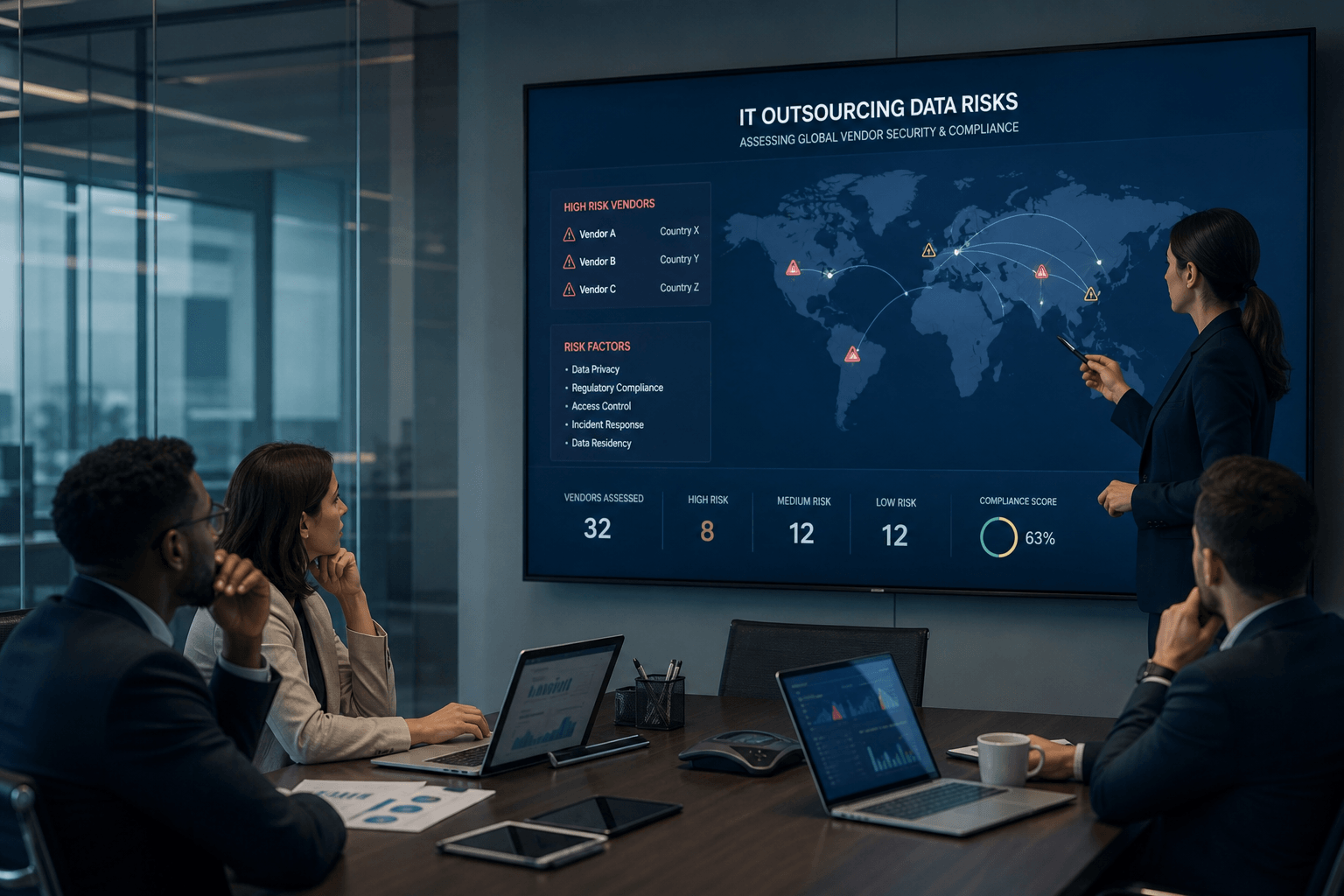
Maintaining consistent quality becomes exponentially harder when teams work across borders. The old model of quality assurance — close supervision and immediate feedback — breaks down in distributed environments.
Quality Challenges in Outsourcing
- Inconsistent testing standards between teams
- Difficulty enforcing coding standards from a distance
- Lack of shared quality metrics and definitions
- Reduced accountability for defects and bugs
- Different definitions of "done" and quality thresholds
A robust defect tracking system and clearly defined key performance indicators (KPIs) help monitor standards, and user acceptance testing (UAT) becomes even more critical when teams are distributed. Performance management also suffers because evaluation becomes harder when AI is involved in service delivery — as one expert explained, "Now you turn it over to AI agents. It's inherently not the same. You can't use the same service level measurements."
Security and Data Privacy Concerns
Sharing sensitive business data with a vendor means trusting them with your crown jewels — a single breach can have catastrophic consequences for reputation and revenue.
- Data sovereignty issues when providers deploy general-purpose AI models on work containing your data
- Access control systems that must be carefully managed to prevent unauthorised access
- Compliance with regulations like GDPR that becomes harder to verify remotely
- Security practices that vary widely between vendors and countries
- Intellectual property that may be exposed or compromised
Intellectual Property Protection
When you share source code, proprietary software, and trade secrets with a vendor, you create potential exposure. IP-related risks include contractual ambiguity around ownership of AI-generated outputs, providers training AI tools on open-source code without proper licensing controls, competitors recruiting from the same vendor, and vendor financial difficulties leading to IP being sold or compromised. Recent litigation in multiple jurisdictions has centred on IP contamination and unresolved ownership issues — strong non-disclosure agreements (NDAs) and explicitly defined IP ownership clauses in the outsourcing contract are essential.
6
Hidden Costs, Vendor Dependency, and Turnover
Cost savings often drive outsourcing decisions, but hidden expenses can quickly erode these benefits. The transaction costs of managing global outsourcing arrangements are much higher than domestic outsourcing due to differences in culture, language, time zone, and geographic distance.
Common Sources of Hidden Costs
Vendor Dependency and Lock-In
When your business depends heavily on a single outsourcing partner, you create a dependency that can become problematic. Vendor lock-in limits your flexibility and bargaining power.
- Limited bargaining power when renewing contracts
- Difficulty switching providers due to integration and knowledge loss
- Vulnerability to the vendor's own business problems — financial trouble or staff turnover
- Loss of internal expertise as your team becomes less involved
- Lock-in with proprietary tools and processes
Some organisations are addressing this by establishing Global Capability Centers (GCCs) that bring work back in-house. These centres grew at 40% in FY24 even as the top five Indian IT companies posted negative to sub-5% growth, and over 65% of enterprises expect to relocate at least 10% of full-time equivalents from third parties to GCCs.
Employee Turnover at the Vendor
Outsourcing providers experience employee attrition like any company — and when it happens frequently, projects suffer. Loss of project knowledge, delays as replacements get up to speed, relationship resets, and quality variation are the typical fallout. GCCs hired roughly 110,000 people in FY25, while India's top IT companies grew headcount by only 13,500 after reducing headcount by 64,000 in FY24 — talent competition that makes it harder for traditional outsourcing vendors to retain skilled workers.
7
Delays, Expectations, and Governance Challenges
Project delays are perhaps the most visible symptom of outsourcing challenges, and they often cascade from the issues already covered.
Root Causes of Delays
- Requirements miscommunication that requires rework
- Limited time-zone overlap for urgent decisions
- Cultural differences in time management and deadline adherence
- Quality issues that require fixing before proceeding
- Dependency on vendor resources with competing priorities
AI Is Shrinking Teams: One former CIO noted his organisation now achieves with 10 to 15 people what previously took 40 to 50 offshore developers, QA specialists, and business analysts — as AI-assisted coding reduces the need for junior offshore roles, some companies are bringing work back in-house.
Managing Expectations
Unrealistic expectations inevitably lead to disappointment and conflict. Set realistic timelines that account for communication overhead, define clear quality standards and acceptance criteria, establish regular check-ins, and document decisions to prevent misunderstandings. Some organisations expect 40–70% productivity gains from AI-enabled services — the reality, according to a recent roundtable of legal and consulting experts, is "often more challenging," requiring operating-model redesigns that most contracts weren't built to accommodate.
Governance and Compliance Gaps
Regulatory compliance adds another layer of complexity. Regulatory deadlines can require rapid action from distant teams — for example, regulators require banks to patch high vulnerabilities within 30 days of vendor releases and emergencies within three days. Post-incident response, compliance verification across jurisdictions, and audit requirements that may conflict with vendor priorities round out the governance burden. When AI is involved, determining which party bears responsibility for AI hallucinations or mishaps has become a crucial part of contract negotiations.
8
Warning Signs an Outsourcing Partnership Is Struggling
Recognising problems early lets you address them before they become catastrophic. Missed deliverables and vendor disputes are the obvious red flags, but subtler patterns matter just as much.
When bots and AI agents fail in outsourced contexts, they can fail at tremendous scale and speed, requiring different protections than contracts written for human-delivered work. That means even small warning signs deserve to be taken seriously and escalated quickly.
9
Which IT Functions Are Safest to Outsource?
Some IT functions are inherently more difficult to outsource than others. Software development projects with complex, evolving requirements tend to face the most challenges.
Innovation and R&D
Requires close, continuous collaboration with business teams — hard to replicate at a distance.
Core Competency Work
Work that differentiates your business deserves the tightest oversight, not the loosest.
Highly Regulated Functions
Complex compliance requirements make remote verification and audit far harder.
Rapidly Changing Requirements
Frequent iteration demands tight, fast feedback loops that distance disrupts.
Infrastructure Management
Standards are well-established, making remote delivery more predictable.
Maintenance & Support
Mature systems with known behaviour are well suited to outsourced support.
Testing & QA
Clear metrics and defined acceptance criteria travel well across distance.
Well-Defined Development Tasks
Clear requirements with little ambiguity reduce the risk of rework.
IT support services, help desk, database administration, and network management often benefit from outsourcing thanks to standardised processes — but nearly half of 400 IT leaders and cybersecurity professionals surveyed cited a lack of in-house expertise as the primary reason for turning to Managed Security Service Providers, so cybersecurity operations still require careful vendor selection.
10
How to Mitigate Common IT Outsourcing Challenges
While the challenges are real, most are manageable with the right approach. Use this framework as a comprehensive risk mitigation strategy.
Best Practices for a Successful Outsourcing Relationship
Strategic Alignment
When C-suite leaders collaborate with business counterparts, they can determine which initiatives deserve the highest focus.
Clear Governance Structure
Establish explicit roles, responsibilities, and decision-making authority. Many clients now require an AI specialist as part of oversight.
Performance Metrics That Matter
Move beyond generic SLAs to metrics tied to business outcomes, like Mean Time to Detect and Mean Time to Repair.
Continuous Relationship Management
Treat outsourcing as a partnership, not a transaction — quarterly business reviews that assess AI usage and value delivery strengthen the relationship.
11
SLAs, Vendor Evaluation, and Collaboration Tools

Careful vendor selection is the first line of defence against outsourcing problems, and a well-crafted SLA is your most important risk-management tool once the contract is signed.
Critical SLA Components
- Clear definitions of services and deliverables
- Measurable performance metrics with specific targets
- Service credit mechanisms for missed targets
- Escalation procedures for problems
- Regular reporting requirements and audit rights
Vendor Evaluation Checklist
Collaboration Tools That Bridge Distributed Teams
Technology cannot solve culture or process gaps on its own, but the right stack makes distributed collaboration far more workable: Microsoft Teams and Slack for messaging and file sharing, Zoom and Google Meet for video conferencing, Jira, Trello, Asana, and Monday.com for project tracking, Confluence for documentation, and GitHub for code collaboration and version control.
12
Startups vs Enterprises, and Future Trends
Outsourcing challenges vary significantly based on organisational size and maturity.
| Challenge Area | Startups | Large Enterprises |
|---|---|---|
| Resources | Limited budget and staff for vendor oversight | More resources, but complex multi-vendor coordination |
| Decision speed | Fast — an advantage and a risk | Slower due to bureaucratic processes |
| Negotiating power | Lower with large vendors | Higher, but legacy systems add complexity |
| Stakes | IT problems can directly threaten survival | Compliance and regulatory burden is greater |
The shift toward insourcing through Global Capability Centers is being driven primarily by large multinationals with the resources to build their own development centres and capture high-value work that previously went to outsourcing providers.
Future Trends Reshaping Outsourcing
Traditional FTE-based pricing models are becoming obsolete as AI reshapes service delivery. Agentic AI introduces new risks when granted permission to access client environments, and CIOs must place limits on autonomous agents — restricting them to use cases where reverting to the original state is straightforward if something goes wrong. Five contract areas need updating for the AI era: AI tool disclosure, explicit prohibitions on using client data for model training, IP ownership clauses for AI-generated outputs, liability frameworks for AI errors, and productivity-sharing clauses.
Measuring Outsourcing Success
Success measurement should go well beyond cost savings, tracking cost performance (actual vs. projected), quality performance (defect rates, customer satisfaction), schedule performance (on-time delivery), strategic performance (business value delivered), and relationship performance (vendor responsiveness and partnership quality). Failed-project research consistently points to the same root causes: underestimating communication complexity, ignoring cultural differences, poor contract management, inadequate transition planning, and a lack of governance once the project starts.
Frequently Asked Questions
The major challenges fall into four categories: coordination and communication gaps, project management and technical deficiencies, vendor relationship and cultural issues, and external and economic constraints. Communication breakdowns are the most frequent trigger, but security, hidden costs, and vendor dependency tend to cause the most severe long-term damage.
Communication breaks down because of language and cultural nuance differences, reliance on written channels without visual cues, limited time-zone overlap, and inconsistent documentation. Even fluent English speakers can misread tone — in some cultures "we'll see" means "no", while in others it means "maybe" — and these gaps compound as messages pass through multiple people.
Sharing source code, customer data, and business logic with an external vendor creates exposure to weak access controls, inconsistent encryption, unclear AI data-training terms, and regulatory compliance gaps across jurisdictions. The global cybersecurity talent shortfall of an estimated 4.8 million professionals as of early 2026 means even vendors may be short-staffed on security expertise.
Build a complete budget that accounts for project management overhead, transition and training costs, scope-change rework, and currency fluctuation — not just the vendor's hourly rate. Define change-request procedures up front, since uncontrolled scope creep is the single biggest driver of outsourcing budget overruns.
Watch for frequent missed deadlines, rising costs without added value, increasing communication breakdowns, unexplained vendor staff turnover on your account, reluctance to share information, and requirement misunderstandings that keep requiring rework. Any one of these appearing repeatedly is a signal to escalate before the relationship deteriorates further.
Infrastructure management, mature-system maintenance and support, testing and quality assurance with clear metrics, and well-defined development tasks outsource well because standards are established. Innovation and R&D, core competency work, highly regulated functions, and projects with rapidly changing requirements carry the highest outsourcing risk and deserve extra oversight.
Webperts pairs strategic alignment from day one with transparent communication protocols, cultural bridge-building, robust project management, and continuous quality monitoring — plus dedicated project managers, clear SLAs, and no hidden fees — so outsourcing functions as a genuine partnership rather than a transactional handoff.
Why Choose Webperts for Your IT Outsourcing Needs?
At Webperts, we understand the complexities of IT outsourcing better than most. We've seen firsthand how communication breakdowns, cultural differences, and project management failures can derail even the most promising initiatives. Our approach is different: strategic alignment from day one, transparent communication protocols, cultural bridge-building that turns differences into strengths, robust project management that catches issues before they become problems, and continuous quality monitoring with clear metrics and accountability.
What sets Webperts apart: no hidden costs or unexpected fees, clear service-level agreements with measurable outcomes, dedicated project managers who understand your culture, scalable solutions that grow with your business, and proven methodologies that minimise risk and maximise value.
Get a Free Outsourcing Consultation →Learn more about Webperts IT Outsourcing services